Front
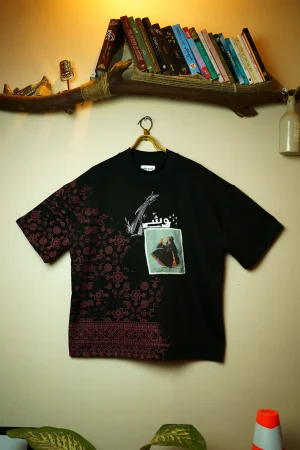
Everything begins with a name Vshey.
A voice that is not just a brand label, but a feeling. A voice that asks everyone it meets, “Are you truly here? Are you connected, or just passing by?”
Beside this name is a traditional Sindhi instrument, a sound that doesn’t speak but is felt. Alongside it are small, timeless Sindhi motifs, deeply connected to the culture, stitched into the fabric. Each line is a story. Each pattern is an identity.
Below that is a patch where a girl is sitting, holding a candle. On her clothes is a symbolic pattern that represents the identity of Sindhi culture not just decoration, but a sign of heritage. She doesn’t just hold a flame, she holds hope. Hope for life. Hope for a better tomorrow. She reflects a quiet strength, a silence that searches for light even in darkness. Her presence is part of a legacy that people may have forgotten, but which still breathes through the fabric we wear.
On the right side of the tee and its sleeve, there is a deep maroon Sindhi pattern, slightly faded, as though touched by time. This design is not just visual. It tells a story of passing time. It reminds us that this culture isn’t from today, it is from centuries ago. A tradition carried through generations, through hands, words, and sounds, now alive again on cloth.
Back
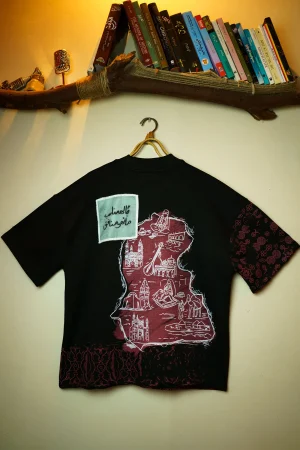
On the back, there’s a large map of Sindh but not just a map, rather a living canvas. Within it lives the soul of every city. From Karachi’s glowing landmarks to Thar’s earthy homes, old clay pots, historic architecture and faces shaped by time, every element is intentionally placed. This isn’t just design, it’s a snapshot of history.
Beside this map, a patch is placed, carrying the words:
“Gaalh munaasib, maaThu munafiq.”
The words might be right, but the face tells something else. This line is not just criticism, it’s a challenge. A reminder that we shouldn’t only speak the truth, but also carry sincerity in our intentions.
At the very bottom of the shirt lies another traditional Sindhi pattern. A design that is more than aesthetic, it is a cultural line. It reminds us that patterns aren’t just decoration, they are heritage. And as long as these motifs are created, our stories will continue to live..